RCEP Mandates ISO 14067 Carbon Footprint Interface for Waste Incinerators
Author
Date Published
Reading Time
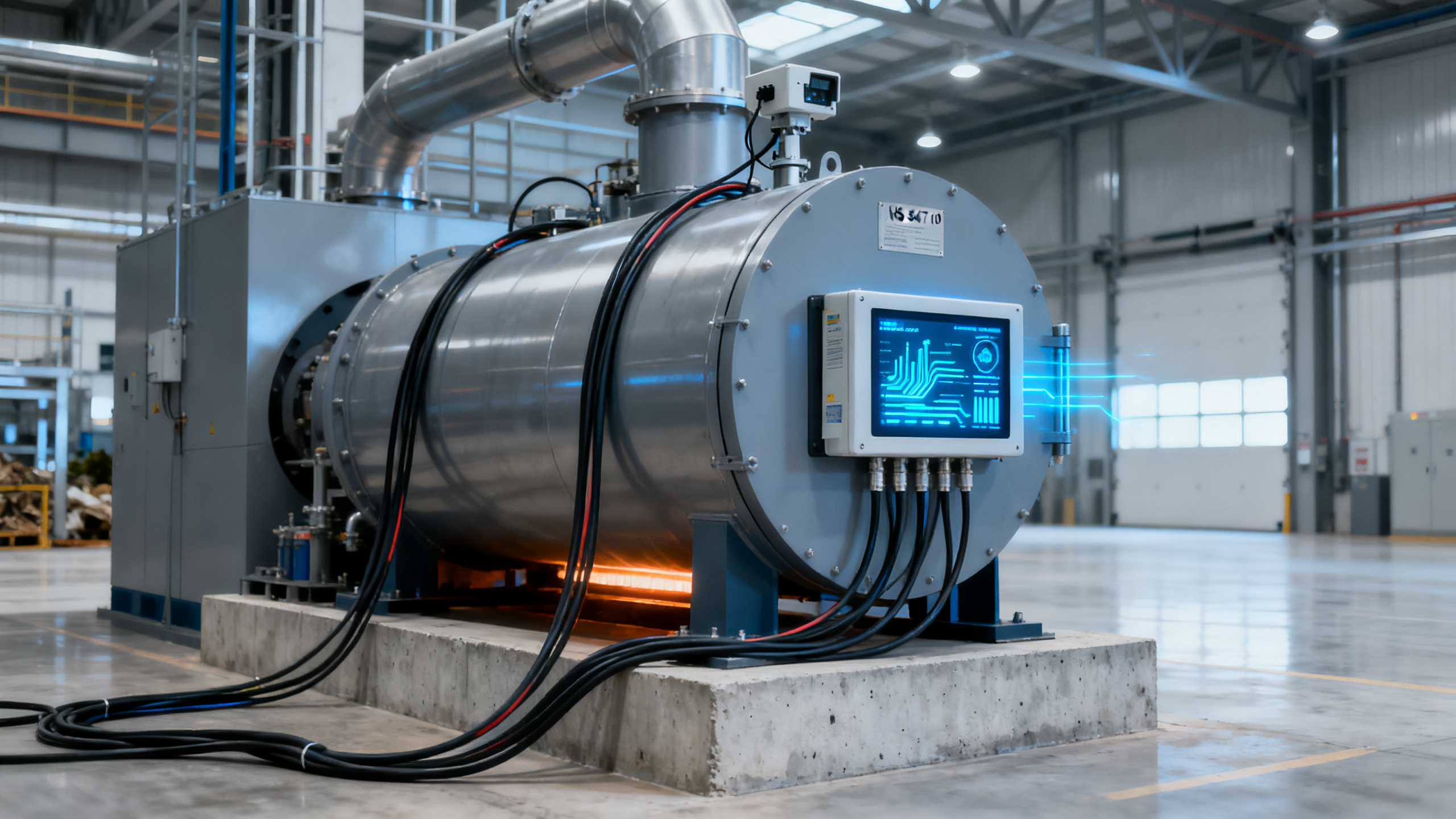
RCEP ASEAN Joint Secretariat issued a compliance notice on April 28, 2026, requiring industrial solid waste incinerators (HS 8417.10) exported to RCEP member states—including Indonesia, Thailand, Vietnam, and Malaysia—to embed a real-time carbon footprint calculation and data export interface compliant with ISO 14067:2018. Enforcement begins June 30, 2026. Manufacturers, exporters, and environmental compliance teams in the waste-to-energy, industrial equipment, and environmental technology sectors should assess integration timelines, certification pathways, and regulatory reporting obligations.
Event Overview
On April 28, 2026, the RCEP ASEAN Joint Secretariat published RCEP Green Equipment Compliance Notice No. 04/2026. The notice stipulates that, effective June 30, 2026, all industrial solid waste incinerators (HS code 8417.10) exported to RCEP countries—specifically Indonesia, Thailand, Vietnam, and Malaysia—must be equipped with an embedded interface capable of real-time carbon footprint calculation and data export in accordance with ISO 14067:2018. The interface must support automatic CSV/JSON upload to national environmental regulatory platforms. Chinese equipment manufacturers are required to complete hardware-software integration and third-party verification within two months of the notice’s issuance.
Industries Affected
Direct Exporters of Industrial Incineration Equipment
Exporters supplying HS 8417.10 units to RCEP markets face immediate compliance deadlines. Non-compliant units risk customs rejection, shipment delays, or mandatory retrofitting upon entry. Impact centers on product certification validity, documentation alignment with national environmental portals, and liability for post-shipment verification failures.
Manufacturers of Waste-to-Energy Systems
Original equipment manufacturers (OEMs) must integrate ISO 14067-compliant firmware and sensor-enabled data pipelines into existing furnace control systems. This affects bill-of-materials planning, firmware development cycles, and factory-level testing protocols—not just final assembly. Integration must cover emissions monitoring inputs (e.g., fuel type, combustion temperature, flue gas composition) aligned with ISO 14067’s life cycle boundary requirements.
Third-Party Certification and Verification Providers
Certification bodies accredited under RCEP-aligned schemes will need to validate both hardware interface functionality and algorithmic conformity with ISO 14067:2018 Annex A (calculation methodology). Demand is expected to rise for auditors familiar with both industrial combustion processes and GHG accounting standards—not merely software API testing.
Environmental Regulatory Technology Suppliers
Vendors offering cloud-based environmental compliance platforms may see increased integration requests from OEMs seeking pre-certified, plug-and-play modules for CSV/JSON export. However, compatibility with each RCEP country’s national platform (e.g., Indonesia’s KLHK e-Reporting, Thailand’s Pollution Control Department portal) remains jurisdiction-specific and unstandardized.
What Enterprises and Practitioners Should Focus On Now
Monitor official technical annexes and national implementation guidelines
The notice references ISO 14067:2018 but does not specify whether national regulators will require additional parameters (e.g., regional grid emission factors, transport-related upstream data). Companies should track updates from Indonesia’s Ministry of Environment and Forestry, Thailand’s Pollution Control Department, and Vietnam’s Ministry of Natural Resources and Environment—each expected to issue operational guidance before June 30, 2026.
Prioritize interface validation for high-volume export SKUs
Given the two-month window for integration and verification, manufacturers should identify top-three best-selling incinerator models destined for RCEP markets and allocate engineering resources accordingly. Retrofitting legacy control systems may require firmware versioning, secure data logging, and timestamped audit trails—elements not always present in current PLC-based architectures.
Distinguish between policy signal and enforceable requirement
This notice applies only to HS 8417.10 products exported *to* specified RCEP countries—not domestic use in China nor exports to non-RCEP destinations like Japan or South Korea. It does not extend to other thermal treatment equipment (e.g., pyrolysis units, gasifiers) unless explicitly reclassified under future notices.
Initiate third-party engagement and internal cross-functional alignment
Compliance requires coordination across R&D, quality assurance, export documentation, and after-sales service teams. Manufacturers should confirm whether their current certification partners hold RCEP-recognized accreditation for ISO 14067 conformance testing—and initiate scoping discussions no later than mid-May 2026.
Editorial Perspective / Industry Observation
Observably, this notice functions less as a standalone regulation and more as a coordinated signal of tightening environmental interoperability requirements across RCEP’s green trade agenda. Analysis shows it reflects growing alignment between trade facilitation mechanisms and climate accountability frameworks—particularly where physical equipment intersects with digital environmental reporting infrastructure. From an industry perspective, it marks the first time RCEP has embedded a specific international standard (ISO 14067) directly into a product-level import condition. Current evidence suggests enforcement will focus initially on documentation completeness and interface presence—not algorithmic accuracy—making verification readiness more urgent than full methodological harmonization at launch.
Conclusion
This notice establishes a new, time-bound technical compliance threshold for industrial waste incineration equipment entering select RCEP markets. It signals an evolving expectation: environmental performance is no longer assessed solely through end-of-pipe emissions, but also via embedded, standardized, and interoperable carbon accounting capabilities. For affected stakeholders, the most pragmatic interpretation is that this is a near-term operational requirement—not a strategic pivot—but one that previews broader digital environmental compliance expectations likely to extend to other industrial equipment categories in subsequent RCEP technical notices.
Source: RCEP ASEAN Joint Secretariat, RCEP Green Equipment Compliance Notice No. 04/2026, issued April 28, 2026. Note: National implementation details—including data schema requirements, acceptable verification bodies, and transitional provisions—are pending publication by individual RCEP member environmental authorities and remain under observation.
Technical Specifications
- 6th National Auto Standards Committee Launched, Impacts Optical Test Equipment ExportAuthor :Precision Metrology Expert
- Copper Price Surge Impacts Industrial Components BOM CostsAuthor :Grid Infrastructure Analyst
- EU CE Update: ULPA Filters Require MVR Testing from Jan 2027Author :Environmental Engineering Director
Expert Insights

Chief Security Architect
Dr. Thorne specializes in the intersection of structural engineering and digital resilience. He has advised three G7 governments on industrial infrastructure security.
Related Analysis
- Apr 29, 20266th National Auto Standards Committee Launched, Impacts Optical Test Equipment ExportAuthor :Precision Metrology Expert
- Apr 29, 2026Copper Price Surge Impacts Industrial Components BOM CostsAuthor :Grid Infrastructure Analyst
- Apr 29, 2026EU CE Update: ULPA Filters Require MVR Testing from Jan 2027Author :Environmental Engineering Director
Core Sector // 01
Security & Safety
- RCEP Mandates ISO 14067 Carbon Footprint Interface for Waste IncineratorsAuthor :Environmental Engineering Director

- RCEP-ASEAN Mandates ISO 14067 Carbon Interface for Waste IncineratorsAuthor :Environmental Engineering Director
![]()
- RCEP ASEAN Mandates ISO 14067 Carbon Interface for Waste IncineratorsAuthor :Environmental Engineering Director
![]()
- RCEP Industrial Waste Equipment Mutual Recognition Takes EffectAuthor :Environmental Engineering Director
![]()
- Industrial sludge in environmental engineeringAuthor :Environmental Engineering Director

- RCEP Industrial Waste Equipment Mutual Recognition LaunchedAuthor :Environmental Engineering Director
![]()
- CIBF2026 Highlights Lithium Battery Recycling Equipment DemandAuthor :Environmental Engineering Director
![]()
- RCEP Industrial Waste Equipment Mutual Recognition LaunchesAuthor :Environmental Engineering Director
![]()