Ball Screws Manufacturer Selection Gets Harder in 2026
Author
Date Published
Reading Time

Choosing a reliable ball screws manufacturer is becoming more complex in 2026 as buyers compare not only price, but also precision, compliance, and long-term supply stability across components like angular contact ball bearings, deep groove ball bearings, and tapered roller bearings wholesale. For procurement teams, operators, and decision-makers, understanding how suppliers position products such as slewing ring bearings and rod end bearings wholesale is now essential to reducing risk and improving system performance.
In practical terms, the selection process is harder because the market no longer rewards the cheapest quote alone. Buyers now need to verify machining accuracy, lead consistency, lifecycle performance, documentation quality, export capability, and after-sales responsiveness. A ball screws manufacturer that looks competitive on paper may still create hidden costs through premature wear, unstable delivery, poor application matching, or weak quality traceability. In 2026, the best choice is usually the supplier that can prove process control, application engineering support, and long-term supply reliability—not simply the one offering the lowest initial unit price.
Why choosing a ball screws manufacturer is getting harder in 2026
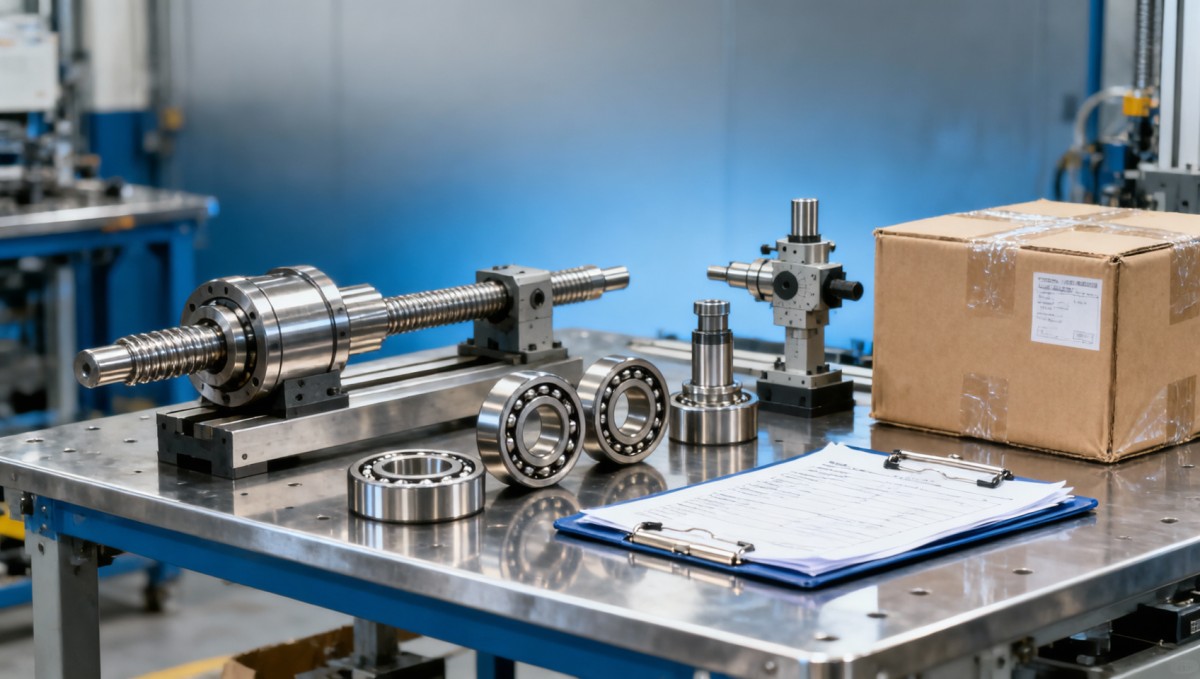
Several shifts are making supplier evaluation more demanding for industrial buyers.
First, performance expectations are rising. Ball screws are used in equipment where positioning accuracy, repeatability, and service life directly affect uptime and output quality. As more systems run faster, carry heavier loads, or operate under stricter quality targets, buyers need tighter confidence in preload control, lead accuracy, surface finish, material treatment, and assembly quality.
Second, global sourcing has become more fragmented. There are more suppliers in the market, but documentation standards vary significantly. Two manufacturers may both claim similar tolerance grades, yet only one can provide complete inspection reports, batch traceability, and application-specific support. This creates a larger gap between quoted capability and proven capability.
Third, procurement decisions are increasingly connected to broader component ecosystems. Buyers comparing a ball screws manufacturer may also be sourcing angular contact ball bearings, deep groove ball bearings, tapered roller bearings wholesale, slewing ring bearings, and rod end bearings wholesale from related vendors or integrated supply partners. This means supplier selection is no longer about one part number; it is about whether the supplier can support a reliable, coordinated mechanical supply chain.
Fourth, compliance and risk management matter more. EPC firms, industrial contractors, and large manufacturers want evidence of quality systems, material control, export readiness, and consistency across production lots. A supplier with poor quality communication can slow approval cycles and increase operational risk even if the component itself appears acceptable.
What buyers actually need to verify before shortlisting suppliers
For most readers, the real question is not “Who claims to be the best manufacturer?” but “How do we separate a dependable supplier from a risky one?” The most useful approach is to verify six areas before moving any supplier into the final shortlist.
1. Manufacturing capability
Check whether the supplier actually controls the key stages of ball screw production or mainly acts as a trading intermediary. Important capabilities include screw shaft machining, thread grinding or rolling, heat treatment control, nut assembly, preload adjustment, cleanliness control, and final inspection. A manufacturer with stronger in-house control usually offers better consistency and faster technical feedback.
2. Precision and quality documentation
Ask for measurable evidence, not generic promises. This may include lead accuracy grades, runout data, axial clearance values, preload classes, noise testing, surface hardness reports, and dimensional inspection records. If your application is critical, request sample reports from previous production lots.
3. Application engineering support
A capable ball screws manufacturer should ask about load, speed, stroke, duty cycle, mounting method, lubrication conditions, contamination risk, and expected life. If a supplier quotes immediately without understanding the operating conditions, there is a higher chance of mismatch and field failure.
4. Supply stability
Lead time reliability matters as much as machining quality. Buyers should ask about raw material sourcing, standard inventory, safety stock options, export packaging, and response plans for demand spikes. For large projects, supply continuity can outweigh a small price advantage.
5. Quality system and traceability
Look for clear quality management processes, nonconformance handling, lot tracking, and corrective action procedures. This is especially important for OEMs, EPC contractors, and regulated industrial environments where documentation may be reviewed long after delivery.
6. After-sales responsiveness
A supplier’s value becomes most visible when something goes wrong. Ask how they handle installation questions, early wear analysis, lubrication guidance, replacement coordination, and root-cause investigation. Fast and technically competent support reduces downtime and protects total project value.
How procurement teams should compare quotes beyond unit price
One of the biggest mistakes in ball screw sourcing is comparing quotes as if all parts are interchangeable. In reality, low purchase price can mask higher total cost if the supplier delivers inconsistent quality, longer downtime, or weaker service support.
A more useful comparison model includes the following:
Total cost of ownership
Factor in expected service life, installation time, maintenance frequency, lubrication demands, replacement intervals, and failure risk. A higher-priced product may be cheaper over the full lifecycle if it lasts longer and reduces machine stoppages.
Inspection and approval burden
Suppliers with incomplete documentation often create hidden internal costs. Engineering, quality, and procurement teams spend more time clarifying specifications, requesting revised reports, and resolving shipment issues.
Operational risk exposure
If the ball screw supports high-value equipment, production lines, or safety-sensitive systems, the cost of failure may far exceed the part price. In such cases, buyers should prioritize process stability and technical support over narrow cost savings.
Standardization opportunity
Suppliers that can support related motion or bearing components may simplify sourcing strategy. For example, if a vendor ecosystem also covers angular contact ball bearings, deep groove ball bearings, tapered roller bearings wholesale, slewing ring bearings, or rod end bearings wholesale, this may reduce supplier fragmentation and improve coordination across maintenance and procurement teams.
What operators and end users should ask that procurement often misses
Operators, maintenance staff, and application engineers often see issues earlier than procurement does. Their input can prevent expensive sourcing mistakes.
They should ask whether the proposed ball screw is suitable for the actual working environment. Dust, moisture, high temperatures, poor lubrication discipline, shock loading, and side loads can all reduce performance. A supplier that understands field conditions may recommend different sealing, lubrication intervals, surface treatments, or mounting arrangements.
They should also verify installation sensitivity. Some ball screws perform well only when alignment, support bearings, and assembly conditions are tightly controlled. If the operating site has limited installation precision, a theoretically high-grade product may not deliver its expected benefit.
Maintenance teams should request guidance on lubrication type, relubrication intervals, contamination protection, and signs of early failure. This information has practical value because long service life depends not only on manufacturing quality, but also on proper use in the field.
Finally, operators should report recurring issues such as vibration, unusual noise, backlash growth, overheating, or inconsistent positioning. These symptoms often indicate a mismatch between component selection and actual duty conditions. A good manufacturer helps interpret those signals instead of simply shipping replacements.
Red flags that suggest a ball screws manufacturer may not be reliable
In a crowded market, some warning signs appear repeatedly. These do not always prove a supplier is unsuitable, but they should trigger deeper review.
- Specifications are vague or copied across different product models.
- Inspection reports are unavailable, incomplete, or inconsistent.
- The supplier cannot clearly explain material grades, heat treatment, or preload options.
- Technical teams respond slowly or only provide sales language.
- Lead times change frequently without a clear reason.
- There is no clear process for complaints, returns, or failure analysis.
- The supplier avoids discussing application conditions in detail.
- Claims of compatibility with related products like angular contact ball bearings or tapered roller bearings wholesale are broad but unsupported.
For procurement leaders and decision-makers, these red flags matter because they usually point to deeper supply chain weakness, not just communication problems.
How enterprise buyers can build a smarter 2026 selection framework
The most effective buyers are moving from one-time price shopping to structured supplier evaluation. This is especially relevant for organizations managing large projects, global equipment fleets, or multi-site maintenance programs.
A practical framework includes:
- Define the application clearly: load, speed, duty cycle, precision requirement, environment, expected life, and installation constraints.
- Create a weighted scorecard: quality capability, documentation, engineering support, lead time reliability, cost, and after-sales performance.
- Request evidence: certificates, inspection samples, case references, and process explanations.
- Validate with a pilot order: test actual performance, packaging, communication, and documentation handling.
- Review cross-component sourcing fit: evaluate whether the supplier can support broader mechanical categories when relevant, including deep groove ball bearings, rod end bearings wholesale, or slewing ring bearings.
- Measure supplier performance over time: track defect rate, on-time delivery, responsiveness, and field failure feedback.
This approach helps both procurement professionals and executives make decisions that align with operational reliability, not just short-term savings.
Final takeaway: the best manufacturer is the one that reduces risk over the full lifecycle
Ball screw manufacturer selection is getting harder in 2026 because buyers must evaluate far more than machining claims or attractive pricing. The real differentiators are precision consistency, application understanding, quality traceability, supply stability, and support after delivery.
For information researchers, the key is to look for proof rather than broad marketing language. For operators and users, the key is to match component design to real working conditions. For procurement teams, the key is to compare lifecycle value, not only quotation totals. And for business decision-makers, the key is to choose supply partners that reduce operational risk and support long-term continuity.
When a ball screws manufacturer can demonstrate technical depth, stable delivery, and credible support across related industrial component categories, the buying decision becomes clearer. In a more demanding 2026 market, that kind of verified reliability is what truly creates value.
Technical Specifications
Expert Insights

Chief Security Architect
Dr. Thorne specializes in the intersection of structural engineering and digital resilience. He has advised three G7 governments on industrial infrastructure security.
Related Analysis
- Apr 23, 2026Deep Groove Ball Bearings Noise Often Starts with InstallationAuthor :Heavy Industry Strategist
- Apr 23, 2026Tapered Roller Bearings Wholesale: Where Price Gaps Come FromAuthor :Heavy Industry Strategist
- Apr 23, 2026Cylindrical Roller Bearings and Heat Build-Up Under LoadAuthor :Heavy Industry Strategist
Core Sector // 01
Security & Safety
- Ball Screws Manufacturer Selection Gets Harder in 2026Author :Heavy Industry Strategist

- Heat sink aluminum profile: Does anodizing reduce thermal conductivity?Author :Heavy Industry Strategist

- T-slot aluminum framing: What slot tolerance causes misalignment in modular assembly?Author :Heavy Industry Strategist

- Pneumatic actuator valves: What supply pressure drop kills response time?Author :Heavy Industry Strategist

- Hydraulic hoses bulk: Why SAE 100R15 isn’t always better than 100R16 for pulse fatigueAuthor :Heavy Industry Strategist

- Piston pumps wholesale: What oil viscosity range avoids cavitation at startup?Author :Heavy Industry Strategist

- Hydraulic gear pumps: How shaft runout tolerance impacts bearing wear in 2026 modelsAuthor :Heavy Industry Strategist

- Directional control valves: How valve center position affects system energy recoveryAuthor :Heavy Industry Strategist