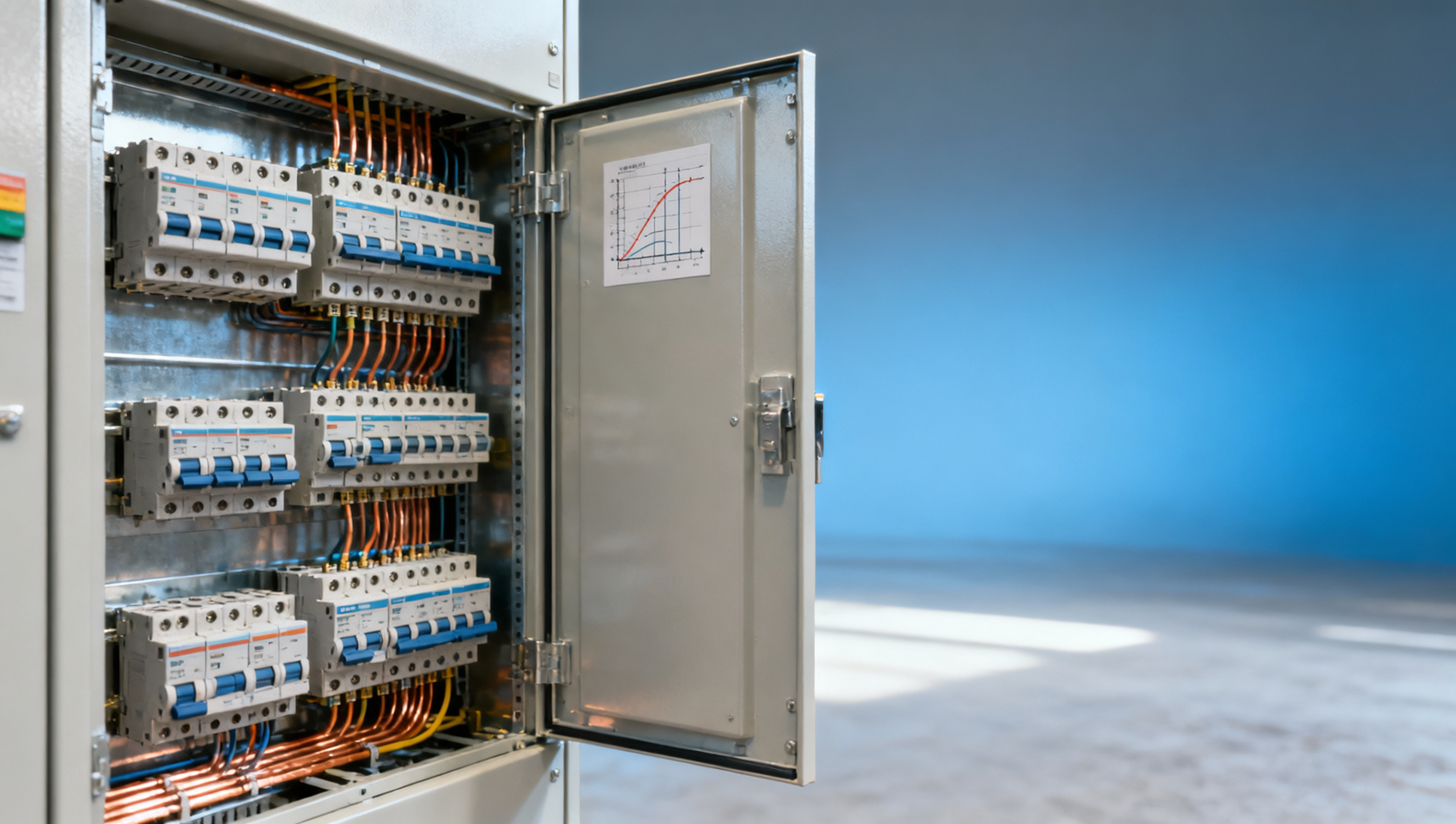
IEC 61850-90-15:2026 Published: 100 ns Time Stamp Mandatory for Substation Relays
Author
Date Published
Reading Time

On 24 April 2026, the International Electrotechnical Commission (IEC) officially published IEC 61850-90-15:2026 — the first standard to mandate 100-nanosecond-level time synchronization accuracy and verifiable timestamp functionality for protective relays and IEDs in smart substations. This development directly affects power system integrators, EPC contractors, and importers selecting protection and control equipment for IEC 61850-based grid projects across the EU, Middle East, and Southeast Asia.
Event Overview
The International Electrotechnical Commission (IEC) released IEC 61850-90-15:2026 on 24 April 2026. The standard formally introduces a mandatory requirement for intelligent electronic devices (IEDs), including protective relays used in smart substations, to achieve ≤100 ns time synchronization precision and support cryptographically verifiable timestamps. Compliance is now a prerequisite for equipment qualification in IEC 61850-compliant smart grid deployments in key export markets.
Which Sub-Sectors Are Affected
Power System Integrators
They are affected because device selection must now include verification of certified 100 ns time accuracy and traceable timestamp generation. Non-compliant relays may invalidate end-to-end system certification under IEC 61850-90-15, risking project acceptance and contractual liability.
Impact manifests in extended procurement lead times, revised testing protocols, and increased reliance on third-party time溯源 (time traceability) reports.
EPC Contractors
EPC firms bidding on or executing smart substation projects in the EU, Middle East, or Southeast Asia face stricter equipment conformity checks during FAT (Factory Acceptance Testing) and SAT (Site Acceptance Testing). Delays may occur if supplied relays lack valid 100 ns time stamp certification.
Impact includes tighter interface coordination with manufacturers, revised commissioning checklists, and potential rework costs if legacy devices are deployed without updated certification.
Relay & Circuit Breaker Manufacturers (e.g., Chinese Exporters)
Manufacturers exporting to IEC 61850-adopting regions must complete new type tests per IEC 61850-90-15:2026 and obtain time traceability accreditation from recognized national metrology institutes or IEC-accredited labs.
Impact includes additional test cycles, longer time-to-market for new models, and possible loss of market access if certification is not completed before tender deadlines.
Importers & Distributors of Protection Equipment
Importers serving regulated markets must verify that incoming relay shipments carry documentation confirming compliance with Clause 7 (Time Accuracy) and Annex A (Timestamp Verification Methodology) of IEC 61850-90-15:2026.
Impact includes added due diligence in customs clearance, expanded technical documentation requirements, and heightened risk of shipment rejection at border or site handover.
What Relevant Enterprises or Practitioners Should Focus On — And How to Respond Now
Monitor official implementation timelines and national adoption status
While the standard is published, national standards bodies (e.g., CENELEC, SAC, SIRIM) may issue transposed versions with staggered effective dates. Current more appropriate action is to track formal adoptions — e.g., whether EN 61850-90-15:2026 will be referenced in EU Grid Codes or ASEAN Interconnection Guidelines.
Verify certification scope for existing and upcoming relay models
Manufacturers and buyers should confirm whether current type test reports cover the full 100 ns requirement — especially the timestamp generation mechanism (e.g., IEEE 1588v2 PTP profile, hardware timestamping path, cryptographic signature chain). Not all ‘precision time’ claims meet the new verifiability threshold.
Distinguish between regulatory signal and enforceable requirement
IEC publication alone does not trigger immediate enforcement. Contractual clauses referencing IEC 61850-90-15:2026 — particularly in EPC tenders issued after Q3 2026 — will determine actual business impact. Monitor procurement documents from major utilities (e.g., TenneT, KEPCO, PLN) for explicit references.
Prepare technical documentation and lab coordination early
Time traceability certification requires calibration against primary time standards (e.g., UTC via GNSS or fiber links) and documented uncertainty budgets. Companies should engage accredited metrology labs now to assess feasibility, lead time, and required firmware/hardware modifications — rather than waiting for tender-driven deadlines.
Editorial Perspective / Industry Observation
From industry perspective, IEC 61850-90-15:2026 signals a structural shift toward metrologically rigorous timing in protection systems — moving beyond functional interoperability to quantifiable, auditable time integrity. It is less an isolated update and more a foundational enabler for future applications such as wide-area fault location, synchrophasor-based adaptive protection, and AI-driven event reconstruction.
Analysis来看, this standard functions primarily as a forward-looking technical gate — its near-term impact depends heavily on how quickly regional grid codes and procurement policies incorporate it. Its real-world weight is still emerging, not yet fully realized.
Current more appropriate understanding is that it establishes a new baseline expectation for high-fidelity time in critical infrastructure, rather than triggering immediate disqualification of non-certified devices across all projects.
Conclusion
IEC 61850-90-15:2026 marks a formal step toward metrological accountability in substation automation timing. Its significance lies not in immediate enforcement, but in defining the technical threshold that will progressively govern equipment eligibility in next-generation smart grid deployments. For stakeholders, the most rational response is proactive alignment — not reactive compliance.
Information Source
Primary source: International Electrotechnical Commission (IEC), IEC 61850-90-15:2026 Edition 1.0, published 24 April 2026.
Note: National adoption status, translation into regional standards (e.g., EN, GB/T), and integration into utility procurement rules remain under observation and are not yet confirmed.
Technical Specifications
Expert Insights

Chief Security Architect
Dr. Thorne specializes in the intersection of structural engineering and digital resilience. He has advised three G7 governments on industrial infrastructure security.
Related Analysis
- Apr 25, 2026China Launches World's Largest Agri-Meteorological Observation NetworkAuthor :Precision Metrology Expert
- Apr 25, 2026Binggang Group & AHUT Advance Steel Slag Valorization TechAuthor :Heavy Industry Strategist
- Apr 25, 2026China Leads First ISO Standard for Zero-Carbon CitiesAuthor :Environmental Engineering Director
Core Sector // 01
Security & Safety
- IEC 61850-90-15:2026 Published: 100 ns Time Stamp Mandatory for Substation RelaysAuthor :Grid Infrastructure Analyst
![]()
- IEC 61850-90-15:2026 Published: 100ns Timestamp Mandatory for Substation RelaysAuthor :Grid Infrastructure Analyst
![]()
- Copper Price Surges 3.8% on Apr 23, Raising BOM Costs for Power ComponentsAuthor :Grid Infrastructure Analyst
![]()
- Copper Price Surge Impacts Breakers & Transformers BOM CostsAuthor :Grid Infrastructure Analyst
![]()
- Copper Price Surge Impacts BOM Costs for Industrial Breakers & TransformersAuthor :Grid Infrastructure Analyst
![]()
- What to Check Before Buying MCCBAuthor :Grid Infrastructure Analyst

- Miniature Circuit Breaker MCB MistakesAuthor :Grid Infrastructure Analyst

- MCCB vs MCB: Which One Fits BetterAuthor :Grid Infrastructure Analyst