Are Precision Die Casting Parts Worth the Cost
Author
Date Published
Reading Time

Are precision die casting parts worth the cost for industrial buyers? When reliability, tolerances, and lifecycle value matter, the answer often goes beyond unit price. From an investment casting manufacturer to cnc machining parts oem, sheet metal fabrication services, and custom metal stamping parts, choosing the right process can directly affect performance, compliance, and procurement efficiency.
For procurement teams, operators, and engineering decision-makers, the real question is not whether die casting is cheaper than every alternative. It is whether precision die casting parts reduce downstream risk, improve assembly consistency, and deliver stable performance across thousands or millions of cycles. In industrial environments where dimensional variation of even ±0.05 mm can affect sealing, fit, conductivity, or vibration behavior, process selection becomes a strategic decision.
This article examines when the higher upfront cost of precision die casting parts is justified, how they compare with adjacent manufacturing routes, and what industrial buyers should evaluate before placing volume orders. The focus is practical: total cost, quality repeatability, material limits, tooling economics, and sourcing decisions that support long-term operational resilience.
Why Precision Die Casting Commands a Higher Price
[[IMG:img_01]]Precision die casting parts usually cost more upfront because the process depends on hardened tooling, controlled mold design, tight thermal management, and stable alloy behavior under pressure. A die set can require 3–8 weeks of development for moderate complexity, and highly detailed industrial parts may take longer if multiple slides, inserts, or vacuum-assisted filling are involved.
However, buyers should separate tooling cost from per-part economics. In many production programs above 5,000–10,000 units, the cost per piece often declines sharply because cycle times can range from 30 seconds to 120 seconds, depending on part size, wall thickness, and trimming requirements. That scale advantage is one reason precision die casting remains attractive for housings, brackets, covers, connectors, pump components, and instrument bodies.
The premium also reflects dimensional consistency. Compared with more manual or lower-repeatability processes, precision die casting parts can reduce secondary machining, lower assembly scrap, and shorten inspection time. If an operator no longer needs to rework hole alignment, deburr heavily, or shim inconsistent dimensions, labor savings can offset part price differences over the life of the contract.
In heavy industry and infrastructure procurement, this matters because hidden costs are rarely visible in a simple quotation sheet. One batch with unstable porosity, warpage, or flash variation can delay installation by 2–7 days, disrupt EPC schedules, and trigger unplanned quality checks. That is why experienced buyers compare process stability, not just line-item price.
What buyers are actually paying for
A higher quote for precision die casting parts often includes value in four areas: process capability, tooling precision, tighter tolerances, and repeatability across volume lots. For industrial procurement, those factors influence acceptance rates, lead-time reliability, and field performance more than headline unit cost.
- Tooling design that supports complex geometries, thin walls, and repeatable gating.
- Production control that stabilizes dimensions over runs of 10,000 pieces or more.
- Surface quality that reduces extra polishing, grinding, or corrective finishing.
- Lower variation in assembly-critical features such as threads, bosses, and mating faces.
The table below shows where the cost premium typically comes from and where industrial buyers may recover that premium through operational savings.
The key takeaway is simple: precision die casting parts are rarely the lowest-cost option at prototype stage, but they often become financially sound when volume, consistency, and reduced rework are part of the evaluation model.
When Precision Die Casting Parts Deliver Better Total Value
Precision die casting parts tend to deliver the strongest return in applications where repeatability is more important than one-time fabrication flexibility. Typical examples include electrical enclosures, actuator housings, meter bodies, heat-dissipating covers, transmission components, and structural brackets used in industrial systems. In these cases, stable geometry across 1,000, 10,000, or 100,000 units supports consistent field performance.
Lifecycle value becomes even more important when parts are installed in difficult-to-service environments. A casting used inside a power distribution cabinet, pump system, ventilation assembly, or safety device may remain in service for 5–15 years. If a cheaper part has higher distortion, weaker thread integrity, or more variation in wall thickness, the buyer may save at purchase and lose through downtime, warranty handling, and replacement labor.
Operational teams also benefit when precision die casting parts reduce installation friction. Better consistency means fewer manual adjustments, more predictable fastener torque, and smoother mating with seals, bearings, or electronic subassemblies. For contract manufacturers and OEMs, even a 2%–4% reduction in assembly inefficiency can materially affect monthly output.
This is why experienced sourcing teams look beyond direct material price. They assess total landed cost, incoming quality burden, machining allowance, rejection probability, and process compatibility with coatings, threading, or post-machining steps.
Applications where the cost is often justified
The following comparison shows where precision die casting parts usually make financial and technical sense, especially when buyers need a repeatable balance between accuracy, surface finish, and throughput.
In contrast, if a project requires very low volume, frequent design changes, or thick-section metallurgy beyond common die-cast alloy behavior, investment casting, cnc machining parts oem, sheet metal fabrication services, or custom metal stamping parts may offer better economics. The process should follow the use case, not the other way around.
A practical value test for buyers
- Estimate annual demand over 12 months and 24 months, not just the first order.
- Quantify the cost of rework, assembly delays, and nonconforming parts.
- Identify features that truly require tight tolerances and features that do not.
- Compare total process chain cost, including machining, finishing, and inspection.
If the answer shows that a more repeatable process saves labor, improves acceptance rate, or lowers service risk, then the cost of precision die casting parts is often justified on a business basis, not just a technical one.
Comparing Die Casting with Other Industrial Metal Part Processes
Industrial buyers rarely choose in isolation between “good” and “bad” manufacturing routes. The more common decision is between precision die casting parts and neighboring options such as investment casting, CNC machining, fabricated sheet metal assemblies, or stamped components with secondary operations. Each process has a distinct cost profile, lead time pattern, and geometry window.
Precision die casting is strongest when buyers need near-net-shape complexity, good surface finish, and repeatability at moderate to high volume. CNC machining can deliver excellent precision and material flexibility, but the per-part cost often rises when geometry requires long cycle times or high material removal. Investment casting supports complex forms and selected alloys, but lead times may extend to 4–8 weeks or more depending on tooling and foundry planning.
Sheet metal fabrication services are effective for enclosures, guards, cabinets, and larger formed structures, especially when design revisions are likely. Custom metal stamping parts are highly competitive for thinner profiles and very high volume, but they may require multiple tools or added forming and joining steps for complex three-dimensional features.
The decision should therefore be based on geometry, alloy, tolerance, annual volume, post-processing needs, and application risk. A sourcing strategy that ignores even one of those factors can create cost leakage later in the production cycle.
Process comparison for procurement planning
The matrix below helps procurement teams compare common industrial metal part routes using practical purchasing criteria rather than generic marketing claims.
For many industrial programs, a hybrid strategy works best. A buyer may use CNC for prototype validation, then shift to precision die casting parts for production, while keeping stamped or fabricated parts for peripheral structures. That staged approach can reduce development risk without locking the project into the wrong cost structure.
How to Evaluate Suppliers and Control Procurement Risk
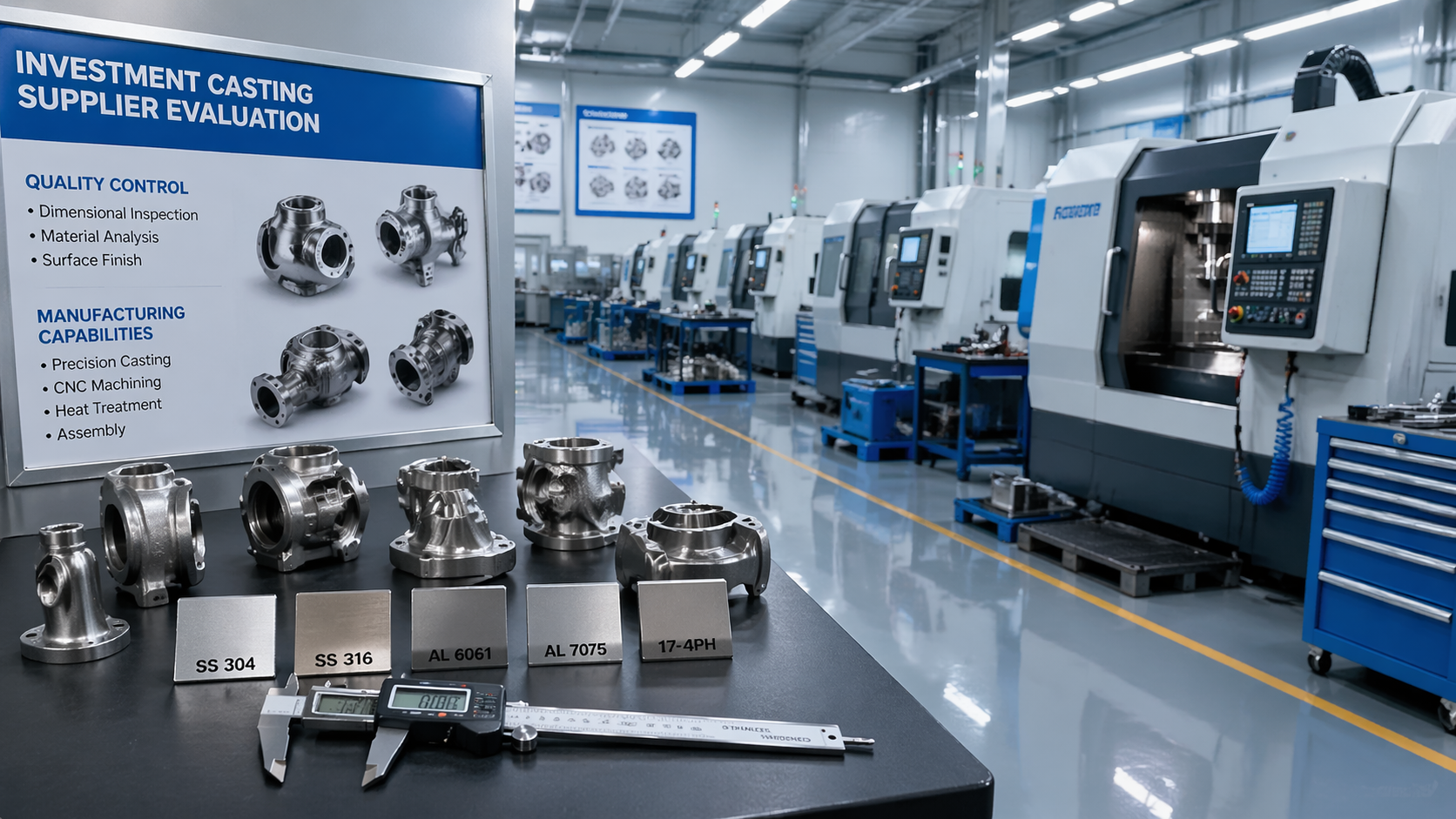
The value of precision die casting parts depends heavily on supplier capability. A competitive quotation means little if the producer cannot hold key tolerances, manage porosity risk, or maintain repeatability from pilot run to mass production. Procurement teams should evaluate the supplier as a process partner, not just a source of metal parts.
A practical supplier review usually covers five areas: tooling design competence, alloy control, process monitoring, secondary machining capability, and documentation. For industrial projects, buyers should also confirm how the supplier manages dimensional reports, first article approval, sampling quantities, and change control after tooling release. A weak engineering handoff can create recurring defects across every lot.
Lead time discipline matters as much as technical competence. Typical pilot-to-production transitions can take 4–10 weeks depending on tooling status, sampling rounds, and finishing requirements. If the supplier cannot explain this timeline in detail, the buyer may face schedule exposure later. Reliable partners normally define milestones for DFM review, mold build, T1 sampling, corrective action, and production approval.
It is equally important to identify what must be machined after casting and what can remain as-cast. Some suppliers quote low casting prices but shift cost into extensive secondary machining. Others optimize the die so only 2–4 critical features need machining. Buyers should compare complete route cost, not isolated operations.
Supplier qualification checklist
- Request tolerance capability on critical features, not only general tolerance statements.
- Review sample inspection plans, including CMM or gauge methods for complex geometry.
- Confirm whether porosity-sensitive areas are identified for sealing, threading, or machining.
- Ask for expected mold life, maintenance intervals, and how wear is tracked over time.
- Clarify packaging, corrosion protection, and lot traceability for export shipments.
Common procurement mistakes
One common mistake is awarding business based only on the first tooling quote. Another is approving a design before defining which dimensions are functional, critical, or cosmetic. Buyers also underestimate the cost of poor communication between casting, machining, coating, and assembly teams. In industrial supply chains, a tolerance stack-up issue can stay hidden until full-volume launch.
To reduce risk, procurement directors should require a structured review covering 3 stages: design-for-manufacture, sample validation, and mass production control. For parts used in safety-related or performance-sensitive assemblies, that discipline is often worth more than a nominal 3%–8% unit price saving from an underqualified source.
FAQ: Practical Buying Questions About Precision Die Casting Parts
Industrial buyers often compare precision die casting parts with other routes only after a cost challenge appears. The better approach is to answer a few practical questions early, before tooling is released and supply commitments are locked in.
How much volume is usually needed to justify precision die casting parts?
There is no universal threshold, but many projects begin to justify die casting economics at roughly 5,000–10,000 units annually, especially when part geometry is stable and secondary machining can be minimized. Below that range, CNC machining or fabricated alternatives may remain more flexible.
Are precision die casting parts suitable for high-reliability industrial systems?
Yes, when the design, alloy selection, tooling, and quality control are aligned with the application. Buyers should evaluate sealing zones, threaded features, thermal loads, and any pressure-sensitive areas. For demanding use, it is wise to define critical-to-function dimensions and inspection methods before first samples are approved.
What lead time should buyers expect?
For a new tool, a realistic planning window is often 4–10 weeks from design review to qualified samples. Repeat production after approval is much faster, often measured in days rather than weeks, depending on order size, finishing, and logistics. Rush schedules are possible, but they should not replace a disciplined validation process.
What should procurement teams prioritize besides price?
Focus on four items: dimensional capability, defect control, total process cost, and supply predictability. A lower piece price loses value quickly if it causes a 2% rejection rate increase, delayed shipments, or extra machining burden. Stable output and fewer downstream problems usually matter more than a narrow quotation difference.
Precision die casting parts are worth the cost when industrial buyers need repeatability, tighter tolerances, lower assembly friction, and better lifecycle economics across sustained production volumes. They are not the right answer for every part, but they are often the right answer where process consistency directly influences uptime, quality, and procurement efficiency.
For sourcing teams evaluating an investment casting manufacturer, cnc machining parts oem, sheet metal fabrication services, custom metal stamping parts, or die casting suppliers, the strongest decision framework is total value rather than unit price alone. If you need help comparing processes, refining specifications, or building a sourcing strategy for industrial components, contact us to get a tailored solution and discuss the right manufacturing route for your application.
Expert Insights

Chief Security Architect
Dr. Thorne specializes in the intersection of structural engineering and digital resilience. He has advised three G7 governments on industrial infrastructure security.
Related Analysis
Core Sector // 01
Security & Safety
- How to Choose an Investment Casting ManufacturerAuthor :Heavy Industry Strategist

- Are Precision Die Casting Parts Worth the CostAuthor :Heavy Industry Strategist
![]()
- Sheet Metal Fabrication Services: What to CheckAuthor :Heavy Industry Strategist

- Custom Metal Stamping Parts: Common Buying MistakesAuthor :Heavy Industry Strategist

- Magnesium Alloy Ingots: What Affects QualityAuthor :Heavy Industry Strategist

- How to Compare Lead Ingots ManufacturersAuthor :Heavy Industry Strategist
![]()
- 2026 Shanghai Fastener Show Launches Zero-Carbon Process ZoneAuthor :Heavy Industry Strategist
![]()
- Shanghai Fastener Show 2026: 1400+ Suppliers, Global B2B MatchingAuthor :Heavy Industry Strategist
![]()