Why some wholesale UV sterilization lamps fail too early
Author
Date Published
Reading Time

For buyers sourcing wholesale UV sterilization lamps, early failure is rarely random—it often points to hidden issues in ballast quality, quartz purity, thermal management, or supplier testing standards. This article explains why some units underperform long before their rated life, what procurement teams should verify, and how industrial users can reduce replacement costs, compliance risks, and downtime in demanding environments.
Why do some wholesale UV sterilization lamps fail much earlier than expected?
In industrial and commercial disinfection systems, a UV sterilization lamp is rarely judged by purchase price alone. Facility operators care about stable UV output over thousands of operating hours, procurement teams need consistent batch quality, and decision-makers want fewer unplanned shutdowns. When wholesale UV sterilization lamps fail too early, the root cause is usually a chain of specification gaps rather than one obvious defect.
A common problem is confusion between lamp ignition and useful service life. A lamp may still light after 6,000 to 9,000 hours, yet its germicidal output may have already dropped below the required dose for air, water, or surface sterilization. In other words, electrical survival is not the same as disinfection performance. This distinction matters in HVAC, water treatment skids, food handling areas, and equipment sanitation lines.
Early failure also appears in different forms. Some lamps blacken at the ends within a few hundred operating hours. Some cycle on and off because the ballast cannot maintain current stability. Others remain lit but overheat in enclosed housings, causing accelerated quartz degradation. In batch purchasing, even a 3% to 5% premature failure rate can create large replacement labor costs across medium- to large-scale installations.
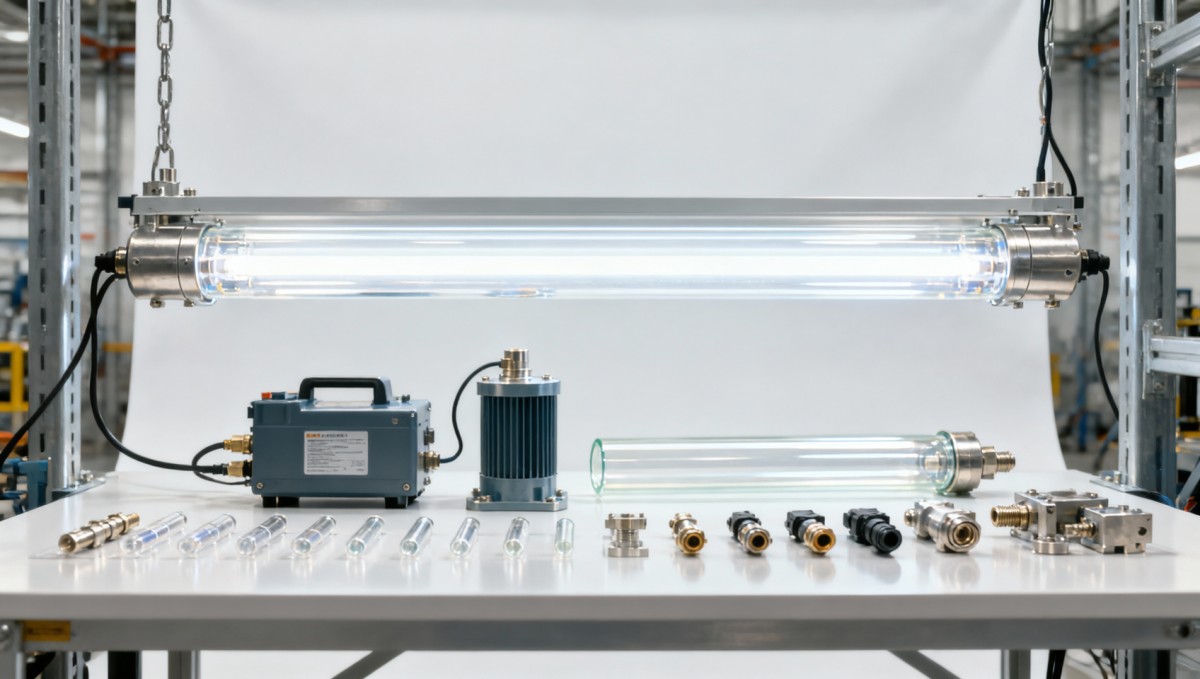
For B2B buyers, the practical question is not whether low-cost supply exists. It is whether the lamp, ballast, sleeve, fixture, and test method were engineered as a system. Global Industrial Core focuses on this system-level view because industrial procurement must balance operating life, compliance expectations, maintenance intervals, and downtime risk, not just unit price on a quotation sheet.
The most common failure paths in real procurement environments
When wholesale UV sterilization lamps underperform, the failure path often falls into 4 categories: electrical instability, material degradation, thermal stress, or inadequate verification. Each one can shorten lamp life by hundreds or even thousands of hours compared with a properly matched system. Buyers who only compare wattage and length often miss these deeper issues.
- Electrical mismatch: incompatible ballast current, poor ignition control, or unstable input power in the 50/60 Hz environment.
- Material quality issues: low-purity quartz, weak electrode sealing, or poor mercury dose control during manufacturing.
- Thermal management failure: restricted airflow, excessive fixture temperature, or sleeve fouling that shifts lamp operating conditions.
- Weak supplier validation: no aging test, no UV output decay curve, and no batch-level consistency checks before shipment.
These causes are especially relevant in wholesale buying because one weak lot can affect dozens or hundreds of installed points at once. That multiplies service calls, inventory waste, and process interruptions. For sectors that depend on repeatable sterilization performance, such as water disinfection and clean utility support, the hidden cost of failure is often far higher than the lamp itself.
Which technical weaknesses usually sit behind early lamp failure?
The technical causes behind premature UV sterilization lamp failure can be assessed systematically. Buyers do not need to inspect every factory process, but they should understand which parameters influence useful life, startup reliability, and UV dose retention. The table below summarizes the most important technical checkpoints for wholesale evaluation.
The table shows why wholesale UV sterilization lamps should be judged as an engineered assembly. If one of these 4 factors is poorly controlled, the rated life on paper becomes unreliable in actual service. This is why many industrial buyers now request not only nominal wattage and base type, but also operating current data, temperature limits, and production test documentation.
Ballast mismatch is more damaging than many buyers assume
A UV lamp that receives unstable current may ignite repeatedly, run hotter than designed, or suffer electrode stress from harsh starting cycles. In facilities with voltage fluctuation, ballast protection becomes even more important. A low-cost ballast may work during bench testing yet fail in field conditions after weeks or months of repeated daily starts.
This becomes critical when lamps are switched frequently. In many installations, operators run 1 to 4 start-stop cycles per day, while some maintenance routines create even more frequent restarting. The more aggressive the switching pattern, the more valuable soft-start behavior and current stability become. Buyers should ask whether the life rating assumes continuous operation or repeated switching.
Quartz purity, sealing, and thermal conditions are closely linked
Quartz purity influences UV transmission, but purity alone is not enough. If end seals are weak or if fixture heat accumulates beyond the intended operating window, the lamp may lose output early even though the quartz specification looked acceptable on the datasheet. Enclosed housings, fouled sleeves, and poor airflow can all push the lamp outside its preferred thermal band.
In practical terms, procurement teams should not separate material quality from application design. A lamp suitable for an open rack may behave very differently in a compact sterilization chamber. For this reason, GIC typically advises buyers to review the full operating environment: ambient temperature, enclosure geometry, run cycle, cleaning interval, and sleeve maintenance frequency, often every month or every quarter depending on fouling conditions.
What should procurement teams verify before placing a wholesale order?
A strong procurement process reduces early failure before lamps ever reach the site. This matters when order quantities move from small trial lots to medium-volume or large-volume replenishment. In most B2B environments, buyers should evaluate at least 5 key checks before approving a supplier, especially when comparing quotations that look similar on basic specifications.
Five checks that prevent expensive mistakes
- Confirm whether life claims refer to lamp illumination life or effective germicidal output life. Those are not identical.
- Request compatibility details for ballast, input voltage range, and installation orientation where relevant.
- Ask for batch testing method, sampling practice, and whether burn-in or aging tests are performed before shipment.
- Review packaging, handling, and transport protection, because fragile quartz and seals are vulnerable in long-distance logistics.
- Verify compliance documents relevant to the application, such as CE, UL, or broader ISO-controlled quality processes where applicable.
These checks are simple, but they separate real manufacturing control from quotation-only trading. In international sourcing, the difference becomes visible after the first 90 days to 6 months of service, when weak lots begin to show blackening, output drop, or unstable ignition. By then, replacement labor and downtime have already started to consume the apparent savings.
For teams comparing multiple suppliers, a scorecard is often more useful than a price sheet. A structured selection matrix helps information researchers, buyers, and managers discuss the same risk factors without relying on subjective impressions.
A scorecard like this makes supplier conversations more concrete. Instead of asking whether a lamp is “good,” the buyer asks how useful life is measured, how batch variation is controlled, and what happens if field claims emerge. That shift improves sourcing discipline and reduces avoidable surprises.
Lead time, spare strategy, and total cost matter as much as lamp price
Many projects focus on unit cost but overlook replenishment timing. Typical wholesale lead times may range from 2 to 6 weeks depending on quantity, packaging, and export documentation. If a site waits until failure begins to accelerate, the gap between order placement and delivery can force emergency purchasing at a higher cost.
A better approach is to align spare inventory with actual replacement cycles. For critical systems, buyers often plan around quarterly reviews, minimum safety stock, and staged replenishment. This is where GIC adds value: not just identifying product data, but helping industrial teams match sourcing strategy with operating reality, compliance expectations, and lifecycle cost control.
How can operators and facility teams extend service life in demanding environments?
Even a well-made UV sterilization lamp can fail early if field conditions are ignored. Operators often assume lamp life is fixed by the factory, but site practice has a direct influence on thermal stress, contamination buildup, and switching-related wear. In many systems, simple operating discipline can extend useful performance and reduce unscheduled replacement work.
Operational habits that reduce premature failure
- Avoid unnecessary on-off cycling. Continuous or planned cycle operation is often less stressful than repeated short runs.
- Maintain sleeve and chamber cleanliness on a set interval, such as monthly in fouling environments or quarterly in lighter-duty applications.
- Monitor fixture temperature and ventilation, especially in compact cabinets, HVAC housings, and enclosed disinfection modules.
- Use trained replacement procedures to prevent handling damage, pin stress, contamination, or misalignment during maintenance.
For operators, one of the most important mindset changes is to treat UV lamps as process components, not simple consumables. If output falls gradually over 8,000 to 12,000 hours, waiting for complete lamp failure may expose the system to disinfection risk long before the lamp goes dark. Scheduled replacement based on service conditions is often safer than reactive replacement.
What changes in harsher installations?
In harsher environments, lamp life may shorten because temperature, dust, vibration, moisture, or chemical exposure affect surrounding hardware. HVAC air sterilization sections, wastewater support equipment, and heavy-duty industrial enclosures each place different stress on lamps and control gear. A specification that works in a lab or office setting may not hold up under plant conditions.
That is why operators should coordinate with procurement and engineering teams rather than replacing lamps by part number alone. If a site repeatedly sees early failure in the same position, the issue may be enclosure heat, power quality, or airflow pattern. Re-buying the same lamp without investigating the operating condition usually repeats the same cost cycle.
What standards, misconceptions, and supplier questions should buyers keep in mind?
In cross-border and industrial sourcing, compliance and documentation shape procurement decisions as strongly as technical performance. Buyers may need evidence related to CE, UL, or ISO-managed quality processes depending on the product category, destination market, and equipment integration scope. While these frameworks do not guarantee long life by themselves, weak documentation often signals weak process control.
Common misconceptions that cause bad buying decisions
One misconception is that identical dimensions mean identical performance. Two lamps with the same length and wattage can behave differently because of ballast matching, quartz transmission, or electrode construction. Another misconception is that the lowest quoted price creates the lowest total cost. In reality, premature failure can add labor, downtime, freight, disposal, and process validation expense.
A third misconception is that a supplier’s “rated life” can be used without context. Buyers should ask whether the rating is based on continuous operation, what percentage of initial UV output defines end of life, and whether the test was performed on production lamps or only on development samples. Those 3 questions alone often reveal how robust the supplier’s claims are.
FAQ for buyers of wholesale UV sterilization lamps
How should I compare two wholesale UV sterilization lamp suppliers?
Compare 5 areas together: useful life definition, ballast compatibility, batch consistency, compliance documentation, and claim-handling process. If one supplier only provides nominal wattage and price while another can explain testing, operating limits, and delivery support, the second supplier usually offers lower operational risk even if the unit cost is higher.
What is a practical replacement planning cycle?
There is no single universal cycle, because replacement depends on run hours, switching frequency, and required UV dose. Many industrial teams review lamp performance monthly, validate critical systems quarterly, and maintain spare stock based on lead times of 2 to 6 weeks. The key is to replace based on validated service condition, not only visible failure.
Do certifications alone prove reliability?
No. Certifications and compliance records are important for procurement and project approval, but they do not replace production discipline or field suitability. Buyers should combine compliance review with technical discussion, sample evaluation, and batch consistency checks. A documented product that is poorly matched to the installation can still fail early.
When should a buyer request samples before a large order?
Samples are especially useful when changing supplier, changing ballast configuration, or moving into a harsher operating environment. A pilot run over several weeks or a few maintenance cycles can reveal startup issues, heat effects, packaging problems, and installation tolerances before a bulk purchase is released.
Why work with GIC when evaluating lamp reliability, sourcing risk, and supplier fit?
Global Industrial Core supports industrial buyers who need more than catalog summaries. Our strength is structured B2B evaluation across technical performance, compliance context, sourcing risk, and application fit. For UV sterilization lamp procurement, that means helping teams clarify whether early failure is likely tied to design assumptions, supplier process gaps, installation conditions, or maintenance practice.
We work in the language procurement and engineering teams actually use: operating hours, replacement cycles, compatibility questions, certification scope, project timelines, and total cost exposure. This is valuable for EPC contractors, facility managers, industrial buyers, and decision-makers who need defensible sourcing choices rather than broad marketing claims.
If you are comparing wholesale UV sterilization lamps for a new project or a replacement program, you can contact GIC for support on 6 practical topics: parameter confirmation, ballast and lamp matching, delivery cycle planning, sample evaluation, documentation and certification review, and quotation comparison across multiple suppliers. These discussions are particularly useful when the application involves multi-site deployment, compliance review, or downtime-sensitive operations.
To move faster, prepare your lamp wattage, base type, operating voltage, enclosure conditions, target application, expected run cycle, and current failure symptoms. With those inputs, GIC can help you screen supplier claims, narrow the right product class, and reduce the risk of buying wholesale UV sterilization lamps that fail too early in the field.
Technical Specifications
Expert Insights

Chief Security Architect
Dr. Thorne specializes in the intersection of structural engineering and digital resilience. He has advised three G7 governments on industrial infrastructure security.
Related Analysis
- Apr 14, 2026How accurate is a true RMS multimeter on VFD signals?Author :Precision Metrology Expert
- Apr 14, 2026When a digital oscilloscope wholesale quote looks cheap at firstAuthor :Precision Metrology Expert
- Apr 14, 2026What changes when an ozone generator goes commercial gradeAuthor :Environmental Engineering Director
Core Sector // 01
Security & Safety
- Why some wholesale UV sterilization lamps fail too earlyAuthor :Environmental Engineering Director

- Ambient air quality monitor missing VOC spikes—response lag or sensor saturation?Author :Environmental Engineering Director

- Japan's METI Updates Green Procurement Priority List: Impacts and Strategies for Affected IndustriesAuthor :Environmental Engineering Director

- Commercial ozone generators don’t scale linearly—why doubling output rarely doubles disinfection in real spacesAuthor :Environmental Engineering Director

- UV sterilization lamps lose over 40% intensity before the first year—how wholesale pricing hides degradation timelinesAuthor :Environmental Engineering Director

- Pneumatic actuator valves behave differently above 6 bar — not just slower, but unpredictablyAuthor :Environmental Engineering Director

- China’s Market Regulator Tightens Cross-Border E-Commerce Food Traceability Rules: Impacts on Imported Ingredients, OEMs, and Cold Chain ServicesAuthor :Environmental Engineering Director

- Yangtze River Delta Carbon Inclusive Platform LaunchedAuthor :Environmental Engineering Director