
IEC 62933-5-2:2026 Standard Release: Impacts on Energy Storage Industry and Key Considerations
Author
Date Published
Reading Time
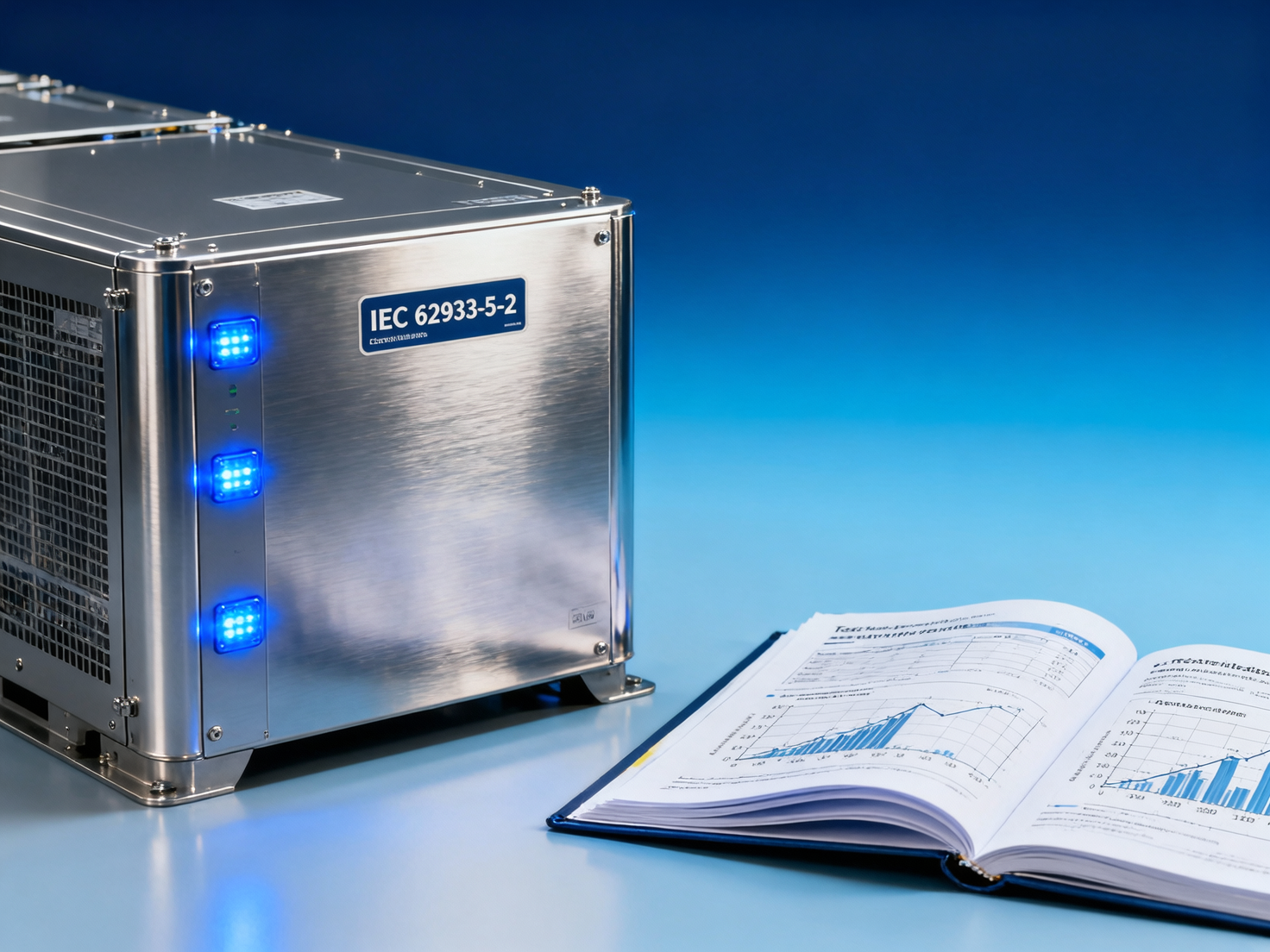
IEC 62933-5-2:2026 Standard Release: Impacts on Energy Storage Industry and Key Considerations
Introduction
On March 25, 2026, the International Electrotechnical Commission (IEC) officially released the IEC 62933-5-2:2026 standard, specifying 12 grid connection performance test methods for electrochemical energy storage systems (including containerized and commercial/industrial-scale systems). This development is particularly relevant for energy storage manufacturers, project developers, and testing/certification bodies, as the standard has already been adopted as mandatory criteria by major markets including Germany, the UK, and Australia. China's equivalent national standard GB/T 36547—2025 was issued in December 2025, creating dual compliance requirements for export-oriented Chinese energy storage systems.
Event Overview
The IEC 62933-5-2:2026 standard specifically addresses:
- Voltage/frequency response during grid disturbances
- Harmonic suppression capabilities
- Black start functionality
- Nine additional performance test protocols
Notably, the standard has been recognized as mandatory for project acceptance by Germany's TÜV, UK's BEIS, and Australia's ARENA programs. China's GB/T 36547—2025 is technically equivalent to the IEC standard, but export products now require dual-standard compliance documentation.
Impact on Specific Industry Segments
Energy Storage System Manufacturers
Manufacturers will need to:
- Update product designs to meet all 12 test requirements
- Modify testing protocols to generate dual-standard compliant reports
- Adjust documentation systems to accommodate both IEC and GB/T references
Project Developers and EPC Contractors
Developers working in international markets must:
- Verify all equipment procurement contracts include dual-standard compliance clauses
- Factor in potential testing timeline extensions for certification processes
- Update technical specifications for new tenders and RFPs
Testing and Certification Bodies
Certification providers should:
- Expand testing capabilities to cover all 12 performance parameters
- Establish parallel testing procedures for IEC and GB/T standards
- Train personnel on interpretation of both standards' requirements
Key Focus Areas and Recommended Actions
1. Compliance Timeline Management
From an industry perspective, while the standard is already effective in some markets, the full implementation timeline may vary. Companies should:
- Monitor regional adoption schedules
- Prioritize testing for high-volume export markets
- Develop phased compliance roadmaps
2. Technical Documentation Systems
Current best practice suggests:
- Creating unified test report templates with dual-standard references
- Implementing document control systems that track standard versions
- Training technical writing teams on parallel standard requirements
3. Supply Chain Coordination
Analysis shows manufacturers should:
Industry Perspective
From an observational standpoint, this development represents more than just technical compliance - it signals the maturation of global energy storage standards. The immediate focus should be on:
- Understanding regional variations in standard implementation
- Balancing compliance costs with market access requirements
- Monitoring potential updates to China's GB/T standard
This appears to be an established regulatory shift rather than a preliminary signal, given the immediate mandatory status in multiple markets.
Conclusion
The IEC 62933-5-2:2026 release establishes a new baseline for energy storage system performance evaluation. For industry participants, the most pragmatic approach currently involves treating this as both a technical requirement and a market access prerequisite. The dual-standard reality for Chinese exporters particularly warrants systematic compliance planning across product development, testing, and documentation functions.
Source Information
- IEC Official Release Notice (March 25, 2026)
- GB/T 36547—2025 National Standard Documentation
- TÜV, BEIS, and ARENA program requirement updates
Technical Specifications
- IEC 62933-5-2:2026 Standard Release: Impacts on Energy Storage Industry and Key ConsiderationsAuthor :Heavy Industry Strategist
- COSCO SHIPPING Specialized Carriers' 2026 Global Partners Conference Highlights Surging Demand for Specialized Transport and 'Made in China' SolutionsAuthor :Heavy Industry Strategist
- Anjie Technology Granted Patent for 'Micro Nut Feeding Fixture', Enhancing Efficiency in Ultrasonic Welding/Riveting and Boosting Stability in Precision Component ExportsAuthor :Heavy Industry Strategist
Expert Insights

Chief Security Architect
Dr. Thorne specializes in the intersection of structural engineering and digital resilience. He has advised three G7 governments on industrial infrastructure security.
Related Analysis
- Mar 28, 2026China Customs Pilot 'New Energy Equipment Export HS Code Pre-Ruling System' - Impacts on Solar Inverter, Energy Storage PCS ExportersAuthor :Grid Infrastructure Analyst
- Mar 28, 2026The 16th China International Clean Energy Expo Concludes with $12.7 Billion in Intentional Deals: Key Takeaways for Industry PlayersAuthor :
- Mar 28, 2026Japan's METI Updates Green Procurement Priority List: Impacts and Strategies for Affected IndustriesAuthor :Environmental Engineering Director