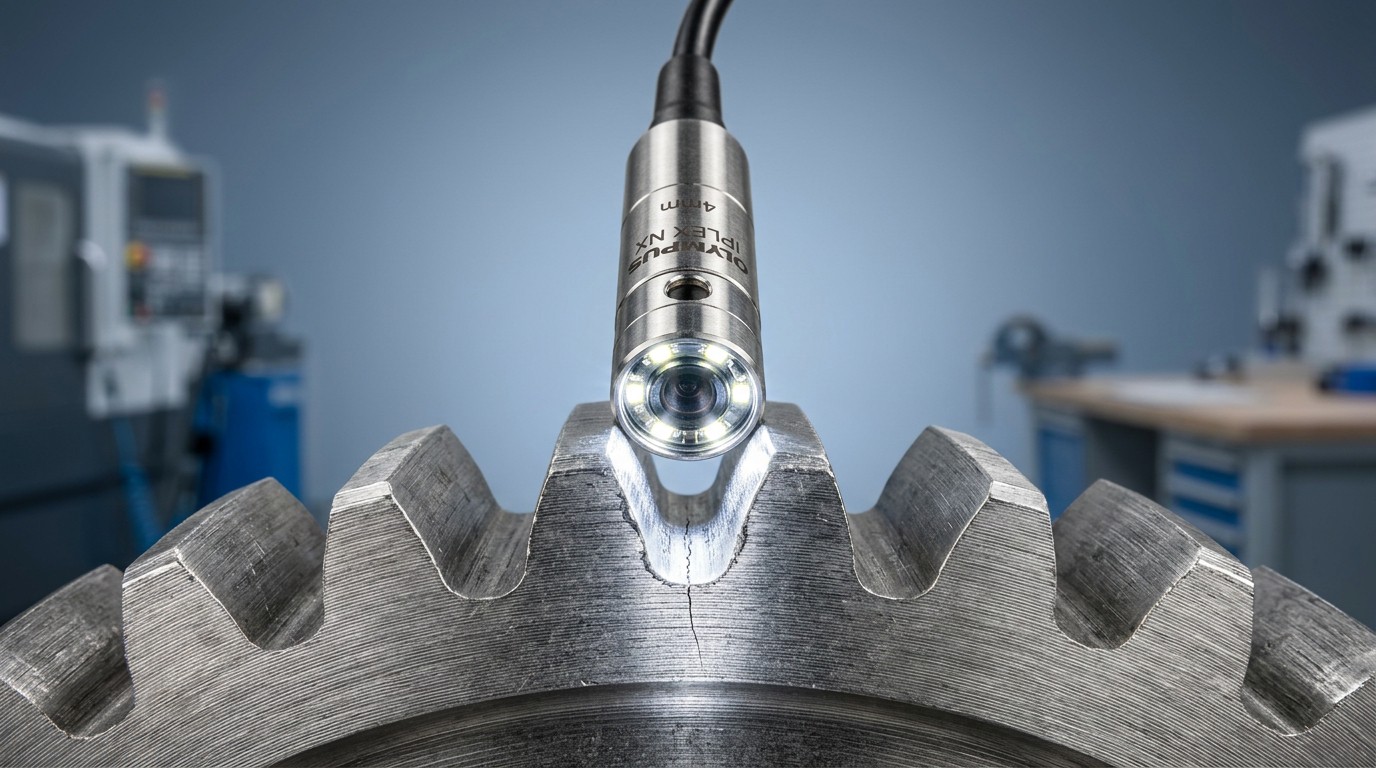
TÜV Rheinland Tightens RF Immunity for Laser Interferometers to 4.5 V/m
Author
Date Published
Reading Time

On April 26, 2026, German certification body TÜV Rheinland released version 3.2 of its Industrial Optical Measurement Equipment EMC Compliance Guide, tightening the radiated RF immunity limit for high-precision optical metrology devices—including laser and white-light interferometers—in the 30–1000 MHz band from 5.0 V/m to 4.5 V/m. This update directly affects manufacturers exporting optical measurement equipment to EU markets, particularly those supplying automotive, semiconductor, and precision engineering sectors where EMC robustness is mission-critical.
Event Overview
TÜV Rheinland published the updated Industrial Optical Measurement Equipment EMC Compliance Guide V3.2 on April 26, 2026. The revision lowers the required radiated RF immunity test level for laser interferometers and white-light interferometers from 5.0 V/m to 4.5 V/m across the 30–1000 MHz frequency range. All new EMC certification applications submitted to TÜV Rheinland for such equipment must comply with this revised limit starting October 1, 2026.
Which Subsectors Are Affected
Export-Oriented Optical Equipment Manufacturers (China-based)
These companies are directly impacted because their products must meet the updated immunity requirement to obtain or renew TÜV Rheinland certification for CE marking and EU market access. Non-compliance may result in delayed certifications, rejected applications, or retesting costs after October 2026.
Precision Metrology System Integrators
Integrators embedding laser interferometers into larger automated inspection platforms (e.g., coordinate measuring machines or wafer alignment systems) must verify that the updated immunity level does not compromise system-level EMC performance—especially when combined with motors, drives, or wireless modules operating in the same frequency band.
EMC Testing Laboratories & Shielding Solution Providers
Laboratories offering pre-compliance testing for optical equipment will see increased demand for full-band radiated immunity scans (30–1000 MHz). Shielding solution providers may experience higher inquiry volume for enclosure redesigns, gasket upgrades, or cable-filtering recommendations targeting the 30–300 MHz subband, where 4.5 V/m poses greater design challenge than 5.0 V/m.
What Relevant Companies or Practitioners Should Focus On — And How to Respond Now
Confirm applicability and scope before initiating redesign
Verify whether your specific product model falls under the guide’s defined scope: ‘industrial optical measurement equipment using coherent or broadband light sources for sub-micron dimensional metrology’. Not all optical sensors (e.g., basic photodiodes or machine vision cameras) are covered. Cross-check device classification against Annex A of V3.2 once publicly available.
Conduct full-band radiated immunity pre-scan testing by Q3 2026
Perform a full 30–1000 MHz radiated immunity scan—not just spot frequencies—to identify resonant vulnerabilities. Prioritize testing at 80–200 MHz, where typical enclosure resonances and cable coupling effects most frequently cause margin loss below 4.5 V/m. Document failure modes to guide targeted shielding or filtering actions.
Review mechanical and cabling architecture—not just electronics
The 0.5 V/m reduction primarily stresses mechanical integrity: seam gaps, display apertures, ventilation mesh, and unfiltered I/O cables become critical paths. Re-evaluate gasket compression force, connector backshells, and shielded cable termination practices. Avoid relying solely on PCB-level filtering; system-level shielding effectiveness determines pass/fail.
Align with TÜV Rheinland’s notified body timeline—not just internal schedules
Submit pre-certification queries to TÜV Rheinland’s EMC team before August 2026 to confirm interpretation of V3.2 for your configuration (e.g., modular vs. integrated units, optional wireless add-ons). Note that transitional arrangements (if any) will be communicated only via official TÜV channels—not third-party consultants.
Editor Perspective / Industry Observation
This update is best understood as a regulatory signal—not yet an enforcement outcome. Analysis来看, the 4.5 V/m threshold reflects growing real-world RF congestion in industrial environments (e.g., from 5G private networks, UWB sensors, and high-speed Ethernet), rather than a fundamental shift in safety philosophy. From industry角度看, it signals increasing convergence between functional safety requirements and electromagnetic resilience in high-accuracy measurement systems. Current more relevant than immediate compliance is the need to treat EMC not as a final-test gate, but as a co-design parameter alongside thermal management and mechanical stability—especially for export-oriented R&D teams.
It is not yet confirmed whether other EU-notified bodies (e.g., SGS, Bureau Veritas) will adopt identical limits, nor whether harmonized standard EN IEC 61326-1 will be amended to reflect this change. These remain key variables requiring ongoing monitoring.
Conclusion
This revision underscores a broader trend: EMC requirements for metrology-grade equipment are evolving from generic industrial thresholds toward application-specific, environment-aware limits. For affected manufacturers, the priority is not urgency—but disciplined, measurement-led adaptation. It is more accurate to view V3.2 as a calibration point for long-term EMC maturity, rather than a one-time compliance hurdle.
Source Information
Main source: TÜV Rheinland’s official announcement of Industrial Optical Measurement Equipment EMC Compliance Guide V3.2, dated April 26, 2026. Publicly accessible via TÜV Rheinland’s Industrial EMC resource portal (requires registered access).
Items under observation: Adoption status by other EU notified bodies; potential alignment with future revisions of EN IEC 61326-1; availability of official interpretation notes for borderline device categories.
Technical Specifications
- Vietnam Requires VILAS Reports for Imported Industrial BearingsAuthor :Heavy Industry Strategist
- 6th National Auto Standardization TC EstablishedAuthor :Precision Metrology Expert
- INMETRO Mandates New IEC 60947-2 Annex Q Short-Circuit Test for Industrial Circuit BreakersAuthor :Grid Infrastructure Analyst
Expert Insights

Chief Security Architect
Dr. Thorne specializes in the intersection of structural engineering and digital resilience. He has advised three G7 governments on industrial infrastructure security.
Related Analysis
- Apr 27, 2026Vietnam Requires VILAS Reports for Imported Industrial BearingsAuthor :Heavy Industry Strategist
- Apr 27, 20266th National Auto Standardization TC EstablishedAuthor :Precision Metrology Expert
- Apr 27, 2026INMETRO Mandates New IEC 60947-2 Annex Q Short-Circuit Test for Industrial Circuit BreakersAuthor :Grid Infrastructure Analyst
Core Sector // 01
Security & Safety
- TÜV Rheinland Tightens RF Immunity for Laser Interferometers to 4.5 V/mAuthor :Precision Metrology Expert
![]()
- TÜV Rheinland Updates EMC Guide for Industrial Optical EquipmentAuthor :Precision Metrology Expert
![]()
- TÜV Rheinland Updates EMC Guide: RF Immunity for Industrial Optical Inspection DevicesAuthor :Precision Metrology Expert
![]()
- SABIC Adds 3 Chinese Optical Inspection Devices to Saudi Green LaneAuthor :Precision Metrology Expert
![]()
- Spotting metal cracks with industrial opticsAuthor :Precision Metrology Expert

- Cemented Carbide Blanks: Which Grade Fits BestAuthor :Precision Metrology Expert

- TÜV Rheinland Updates EMC Guide: RF Immunity for Industrial OpticsAuthor :Precision Metrology Expert
![]()
- SABIC Adds 3 Chinese Industrial Optics Devices to Saudi Safety White ListAuthor :Precision Metrology Expert
![]()